Testimony

Friday, July 06, 2007

MV3 - the machine

I just spent a week with MV3.

Lying in the dark watching the operating head wheel in the gloom like a telescope, lying on my table with padded legs and headrest, like some astronomer on his couch.

Watching laser beams align, assistants call out calibrations, setting up.

But this is no glimpse of the Cosmos - this is almost time travel.

MV3 is (I think) a cavity magnetron.

It will push electrons and neutrons (if it needs) through my tissues as if they aren't there, easing bone pain, untrapping nerve endings, reducing lesions.

Giving me some relief - some hope - a little extra time.

Bless you MV3.

Labels: ,

Thursday, November 23, 2006

A date with Destiny! - or is it History?

Today, 23rd November, is a day that will always stand out for me, for several reasons.

Reason 1

On this day in 1969, I made my first parachute jump. At about 1220 hrs I climbed out onto the wheel of a Cessna 172, registration 5B-CAR, 2500 feet above Kingsfield Airstrip, in Cyprus.
John's first jump, 23 November 1969

Some 2 minutes later I was safely on the ground, surprisingly close to my intended landing site.

Parachutes were nowhere near as sophisticated in those days as today, and the landings alone were enough to put most rational people off, but I persisted, slowly, making an average of one jump per week for the next 2 years, and graduating to rather better parachutes as time wore on.

I quickly progressed from basic *static line* jumping, where the chute opens as one falls away from the plane, to free fall jumping, and before I left Cyprus in 1971 I had progressed to delayed falls of over 30 seconds.

Back in England I found some good groups to jump with, although I never became terribly proficient at formation jumping (*relative work*), though i did some nice *small stuff*, but i found that I enjoyed demonstration and accuracy jumping.

I became a sport parachute instructor in 1973, and worked until 1977 for two different clubs, The Sport Parachute Centre, at Grindale, and the Peterborough Parachute Centre, which was an amazing experience.
Instructor Kiwi John at the Peterborough Parachute Centre

In 1977 I was about to take up a job with a major parachute company, when i was invited to be Chief Parachute Instructor of The Free Fall Parachute Club at Langar, near Nottingham.

It was weekends only, and for a few months of the summer it was a wonderful time, but eventually I had to quit, in favour of my job. Plus I found myself at odds with other instructors, because i was siding with a renegade operator....

In another blog I mention some of the work I did for the parachute company I worked for, and that too was a fantastic time. I had the opportunity to work with the military sometimes, and get behind the scenes in curious situations.

I almost became the first UK civilian to jump from a Royal Air Force Chinook helicopter in the course of my association with the RAF, but they declared that it hadn't been cleared for free fall yet. Like - all you did was jump over the back - people had done that for years with other services!!! Typical military thinking in Britain!!

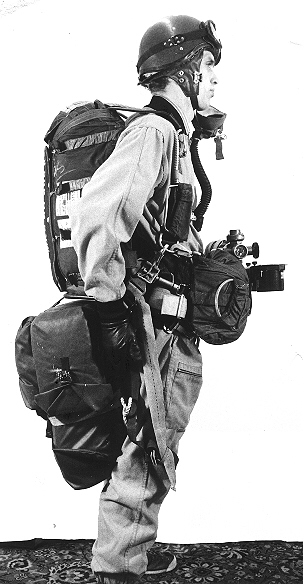
But i did get to ride in some other military aircraft, and often jumped the RAF's remaining Argosy, as well as a Hercules. My 600th jump was from the tail of a Hercules, dressed more or less like this....

Kiwi John dressed for action, military style!!

One curious aspect of my demonstration parachuting was an involvement, through one of our company directors, in aerophilately. Crudely put that's stamp collecting with an aviation theme, and in this case the theme was commemorative covers delivered by parachute. These were decorative envelopes issued to celebrate special events, and I found myself making several demonstration jumps into strange and wonderful places carrying boxes of covers. On one occasion i dropped into the RAF Museum at Hendon, to hand the covers to legendary fighter pilot Sir Douglas Bader, and on another I landed in the grounds of Sandringham Castle with covers to celebrate the royal wedding of Charles and Diana. (see below).


My last season of jumping was in 1983, shortly before I was married, and I think my last jump was a demonstration into the local mental hospital - they always said you had to be mad to go there!!!

In all I made just short of 700 jumps, some far more memorable than others. The final picture is one of the best - a solo drop into Kensington Palace, London, carrying a box of commemorative covers.

Free fall over London

Reason 2

On this day in 1963, the first episode of Doctor Who was shown, in Britain, and I watched it with my brother.

Doctor Who has become the longest-running science fiction series on TV, although it started out with an educational intention. Much, much more about the programme can be found in this Wikipedia entry.

That I saw the programme at all was amazing, since we didn't have a TV at home at the time, but my brother and I were on a permanent invite to go *two doors down* to our neighbour, whose son we went to school with.

We would watch the evening children's broadcast, which would include such stuff as Captain Pugwash and Noggin the Nog, together with Popeye the Sailor and Looney Tunes, and as soon as the theme for the evening news began, at 6 pm, we would troop home again for dinner.

It was when I was getting my facts straight for this blog that I realised how much my memory had changed events, however slightly, and this brings me to Reason 3 for remembering this date.

Reason 3

For years, in fact until this week, I had somehow believed that when we got home from watching the first episode of Doctor Who, we found our parents in a state of shock over the assassination of President Kennedy.

But in researching for this blog i realised that JFK had been assassinated at 6.30 pm (our time) on Friday, 22nd November - that is, 24 hours earlier.

It's not impossible, but highly improbable, that our parents didn't find out until the evening radio news on Saturday, and so my memory of those days must have been combined.

History, they say, is not what happened, but what we remember happened, and for 43 years I have associated JFK's assassination with Doctor Who - close, but not close enough......

Labels: ,

Wednesday, November 15, 2006

The war I never went to

In the mid 1970s my world was parachutes!

I had begun parachuting (skydiving) in November 1969 although it was strictly sport jumping, even though I was then in the Royal Air Force (RAF). I did make 2 military jumps for aircrew training, but that was all.

After I left the RAF in late 1973, I trained as a sport parachute instructor, and worked professionally for 4 years at two leading parachute centres in Britain. It was a wonderful time, training a long string of novices, and then persuading them to step out of a plane at considerable height!

Plus I made demonstration jumps at public events – great for the ego, if sometimes a little tough on the nerves….

By 1977 I was ready for a change (to cut a long story short), and I interviewed for a job at a major parachute manufacturer north of London. It was a junior position to begin with, but I oversaw various small design projects, and helped with different aspects of parachute development. Then one amazing day, I was officially adopted as the company test jumper, and began to make live jumps on our prototype parachutes.

A small development team was formed to design a new type of chute for the military. The square (or ‘ram-air’) parachute is common now, but in the late 1970s it was still relatively novel, and the military were keen to take advantage of the greater performance the design offered.

The design that emerged was a canopy of about 32 square metres, much larger than today’s parachutes, but large enough to support a fully equipped airborne soldier. The company designation was rather mundane: ‘PB11’, but it was also named ‘Skyknight’, and that sounded far more glamourous. I made the first live jump on the prototype chute in January 1980, and went on to use it for regular ‘fun jumping’ and demos, as well as taking it overseas (Pakistan, Italy and Denmark) to demonstrate to other potential military customers.

We produced another 22 assemblies for pre-production assessment by our ‘clients’, and in a parallel development we even built a radio-controlled version, which eventually hit the ground at considerable speed, and ended THAT programme forever!

In the excitement of running development programmes, it’s easy to forget the end use of the equipment being worked on. Even easier, in peacetime, to ignore the military role that our equipment could play in conflict. And we never dreamed…

In a few weeks in 1982, things changed. In the middle of Anglo-Argentine talks to try to resolve issues of sovereignty over the Falkland Islands (Las Islas Malvinas), Argentinian Special Force troops came ashore near Stanley in the early hours of Friday 2nd April, and in the course of the day succeeded in overwhelming the British garrison, and capturing the Governor-General, Rex Hunt.

Reinforcements rapidly arrived from the mainland, and the islands were secured in Argentine hands. The scene was set for the 10-week Falklands Conflict.

The Easter holiday was the following weekend, and in England most of us went about our normal business. During the long weekend I met my future wife for our second date, and we went paragliding. Easter Monday was a holiday too, of course, so it was back to work on the Tuesday the 13th.

I arrived at work at 8 o’clock on Tuesday morning, as usual, and was met at the door by my boss, CJ. Something was clearly up, and he rushed me across the road to the No 1 factory to meet a man (called Chris, I think) who was driving a very plain yet obviously military Land Rover.

Chris had come from Hereford, base for the Special Air Service Regiment, and in his Land Rover he had 11 of our Skyknight assemblies. The task was for the factory to check, modify and repack all 11 before close of business - before lunch preferably. The procedure required that all assemblies be unpacked, and stripped down to their basic components.

Production and Inspection would examine each of the sub-assemblies straight away, and any repairs or modifications (to bring each assembly to the current standard) would be done immediately. Then the Chief Packer and his merry man would re-assemble and repack each reserve parachute, whilst I would pack the main parachutes. This was far from standard procedure, but in the circumstances, nobody thought anything of it.

CJ organized a packing area, by taking over the games room next to the staff dining room. We cleared away the table tennis table, and that gave enough floor space to lay out and pack the Skyknight main parachutes. We hadn’t then mastered packing a ram-air parachute on a bench – it was normally done on the ground anyway - so it was easier to go with what we were familiar with.

Inspection kindly gave me an assistant. Our chief inspector (who was a casual jumper himself) found one of the girls in inspection, Hazel, who had also done a parachute course, and he arranged that she and I would pack the chutes up to the point of attaching them to the harnesses.

It was a huge task really, but we got stuck into it, and systematically worked our way through the growing pile of inspected main canopies. Time went by very fast, and we worked very well together, Hazel and I.

I don’t recall when we finished, but I seem to think we worked into lunchtime, as a number of workers were a bit put out, initially, that they couldn’t get in to play snooker or table tennis.


(I forgot this bit in the original writing) It should be mentioned that when colour schemes for the parachutes was selected, a pale blue material, called *Air Superiority Blue* was chosen, The top and bottom surfaces of the canopy were made in this colour, so that if used in typically cloudy conditions, it would be difficult to see the parachutes descending. The ribs which joined the top and bottom surfaces together, and gave the canopy its wing-like shape were made from white material, for performance reasons.

Somewhere in the midst of all the packing a thought struck me, and i asked out loud *What are the Argentine national colours?*. Everyone standing about began to laugh - in the terrible irony of the moment, we were surrounded by bundles of pale blue and white cloth


Eventually it was done. The packed main parachutes were attached to their harnesses and closed into their packs by the Chief packer, and Chris loaded up his Land Rover and was off. I had no idea what the plan was, but it was obvious that the SAS was getting serious, and the Skyknight was likely to be used in anger.

On Wednesday we did the whole thing again!!! The other 11 parachute assemblies had been found, and once more driven overland in the early hours. We discovered during the day that the first batch of parachutes had been taken directly to waiting troops, and they had made a night jump into Wales (into a region resembling the terrain of the Falklands) by way of a training exercise. Clearly the SAS were getting serious.

Nothing more was heard of our equipment. The SAS are very secretive, and would even decline to mention parachute problems when it might ‘give the game away’.

But weeks after the end of hostilities I had cause to visit one of the military trials units, where our parachutes were evaluated by the Air Force. During conversation one of the technicians referred to a plant pot full of moss from Pebble Island, which stood in his office.

‘How did you get moss from Pebble Island?’ I asked him


‘It came back in one of your Skyknights’, was the reply.

They must have picked it up when they collected all the equipment after the war was over.

I never left England, but in a sense I was there.

Labels: ,

Tuesday, October 10, 2006

Something about Kiwis

In the ESL chatroom, where I spend a fair amount of time, I use the nickname *Kiwi John*, and this frequently causes some odd or even facetious remarks about the nature of Kiwis. Many ask if I'm a fruit, and few (but a significant few) guess that I'm in New Zealand. So here are a few interpretations of *Kiwi*, together with the right answer.

There are actually 5 definitions of Kiwi, and although one of them is very obscure it won't stop me from mentioning it...

To cut to the chase, The first use of *Kiwi* is to name the flightless bird unique to New Zealand. Also called Apteryx, the Kiwi covers several species of various sizes, from bantam hen size up to good-sized chicken. In the wild the Kiwi lives in forest and bushland, and hunts at night for grubs and insects under the surface. That's why it has such a long beak, which is unique in having nostrils at the tip - no other bird has this. Kiwis are endangered, and facing extinction.

The second use of *Kiwi* is as a nickname for a New Zealander, probably because the Kiwi emblem was used to distinguish NZ troops in the past. This is the real reason why I use the nickname *Kiwi John*, even though I'm not actually a native New Zealander.

Then we have the fruit. The confusion here comes because the rest of the world calls a *Kiwi* what we properly call a *Kiwi-fruit*! Long ago New Zealand began commercial cultivation of the Chinese Gooseberry, and the name was coined partly because of the similarity to a kiwi (brown and fuzzy), and also because it now came from New Zealand.

Fourth definition is a famous brand of shoe polish, seen around the world.

And finally the obscure one - an American nuclear reactor/rocket motor project, about which we shall say nothing, being nuclear-free and all that.

After all that, let me explain the photo: taken on a rare opportunity at the Auckland Museum, it shows Kiwi John the person with a Kiwi bird. (The bird is the brown one, and it's stuffed)

Labels:

40 Years as the Crow Flies

40 years ago today I was a young man aged 17 years and 36 days.

Just a month earlier, straight from school, I had joined the Royal Air Force as an apprentice photographer, a member of 307 Entry at RAF Cosford.

The first weeks were spent learning to march, salute, carry a rifle and keep out of trouble. Not to mention cleaning everything in sight.

But we also, my group, began photo training.

At first we stayed in the School of Photography, learning some theory, darkroom procedures and studio techniques, but finally, on 10th October 1966, we ventured outside, and with a Corporal in charge of us, roamed the camp and surrounding area in search of photos.

We photographed buildings, cars, cyclists, a train, a plane, and each other.

This picture was taken by my classmate Steve McAdam.

It was 40 years ago today - when you say it fast it's not too far at all, as the crow flies.

Labels: ,

Monday, October 09, 2006

John of Arabia

Well this may not be the definitive picture of me, but it's one of the best and most recent, and i took it myself!!

I'm wearing a shemaq, a gift from a friend in Saudi Arabia (thanks Melody from ESL Chat)

Sad Rose, another Saudi friend from ESL Chat was visiting Auckland in August, and very kindly showed me how to wear the thing properly, and supplied some extras which make it all the more authentic.

It's fair to say that I'm interested in Middle Eastern culture, for reasons which may or may not become clearer later.

Labels: ,


Content (except where noted) Copyright © John R Nickolls 2006